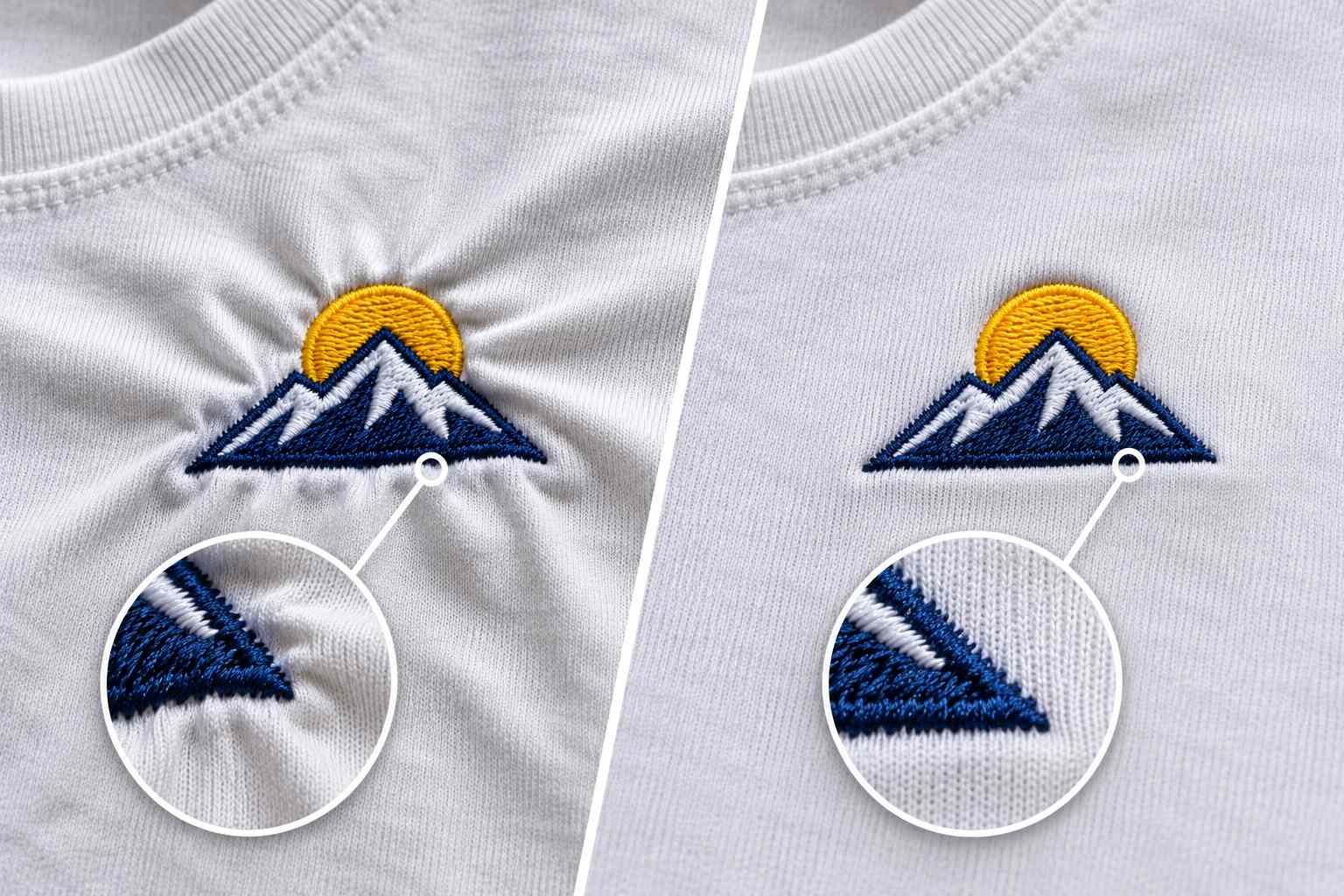


Embroidery puckers around a small logo when the lightweight cotton jersey cannot remain stable against the pull of the stitches. Dense lettering, overlapping objects, heavy underlay, unsuitable backing, stretched hooping, or incorrect machine setup can each draw the knit inward or let it move during sewing. A compact logo is not necessarily a low-stitch design; thousands of penetrations can be concentrated in a small area. Troubleshooting therefore requires more than reducing density. The operator should examine the relaxed garment, stitch file, stabilizer, hooping, threading, tension, and needle as one production system before changing any setting.
Why is Lightweight Cotton Jersey Prone to Puckering?
Cotton jersey is formed from interlocking loops rather than the crossing yarns of a stable woven fabric. This gives a T-shirt stretch and recovery but also allows movement under repeated needle penetration. Thread can pull the loops toward the embroidered area, producing edge ripples. Weight matters, yet knit construction, finish, and recovery also affect stability; lightweight cotton shirts do not all behave identically.
Judge puckering after the garment leaves the hoop and relaxes. A temporary hoop mark follows the ring and may ease after suitable finishing. Stitch-related puckering remains connected to the design and often radiates from its edges. The symptoms can appear together but do not prove the same cause.
How Can a Small Logo Create Excessive Stitch Stress?
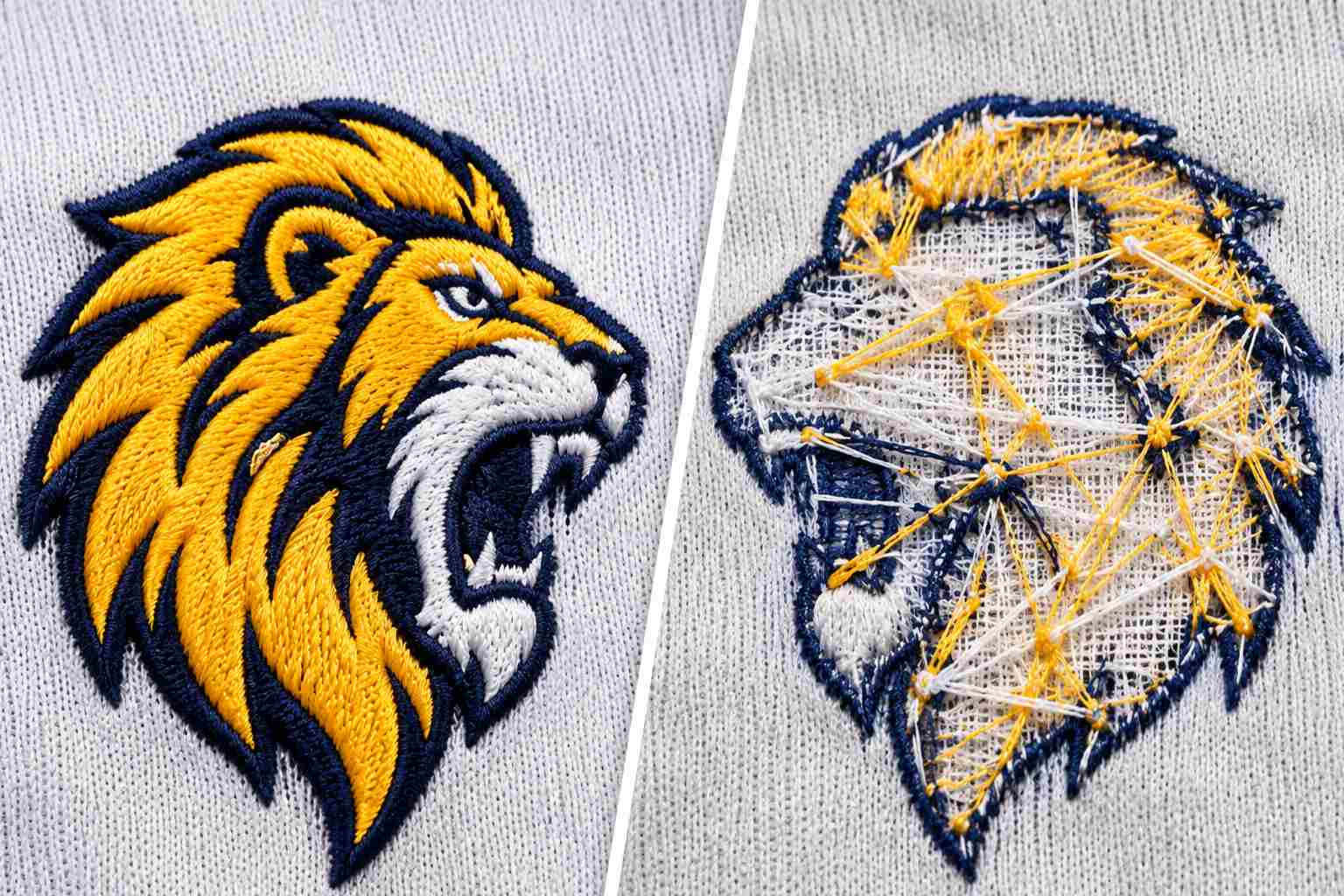
Physical size and local stitch concentration are different. A compact logo may contain tight satin lettering, dense fills, stacked outlines, duplicated objects, and underlay. Where layers overlap, the fabric receives repeated penetrations and several directions of pull. A stiff center can then draw the softer jersey inward.
Reducing top-stitch density alone may leave heavy underlay and hidden overlaps untouched. Removing too much thread can expose the shirt or weaken lettering. Review cap and heavy-polo files because structured garments tolerate loads that thin T-shirts may not. Ask where stitches accumulate and whether every layer has a purpose.
How Do Underlay, Direction, and Sequence Affect Puckering?
Underlay creates a foundation for top stitches, but excessive edge runs, zigzags, or overlapping support add bulk. Too little may allow satin columns or fills to sink, narrow, or move. The right construction depends on the object, jersey, top stitching, and backing.
Direction determines where thread pull acts on the knit. Dense objects sewing similarly can draw one area inward, while later objects enter fabric compressed by earlier ones. Pull compensation can preserve coverage where columns narrow, but excess may increase overlaps. A preview shows geometry and order, not the shirt’s physical response.
Can Stabilizer Choice Cause T-Shirt Embroidery Puckering?
Lightweight knit needs backing that limits movement. Cutaway is commonly used for T-shirts because it remains beneath the embroidery during wear and laundering. Tearaway gives temporary support and may suit stable materials or light designs, but its removal leaves less continuing support. Flexible knit can then pull out of shape.
Choose backing for the fabric’s stretch, stitch concentration, drape, and use. Backing should extend beyond the sewing field and remain securely controlled with the fabric during the run. More or heavier backing is not an automatic fix: it can make a logo rigid or hide a file or hooping problem. Follow product instructions and test the garment combination.
How Do Hooping and Machine Setup Affect the Result?
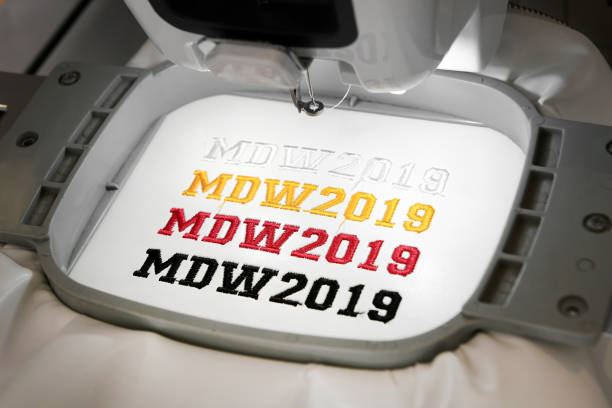
Secure the shirt smoothly without stretching it beyond its relaxed dimensions. Stretched jersey contracts after release while the stitched area cannot recover equally, creating waves. Uneven pressure or an oversized hoop may also permit movement. Use the smallest practical hoop that provides safe design clearance. Inspect the back so folds, seams, or another garment layer are not caught.
Threading, upper and bobbin tension, thread delivery, and needle condition can contribute to pulling or poor stitch formation. Check them against manufacturer guidance. A wrinkle does not prove tension is wrong; inspect bobbin balance and the thread path, and correct machine faults separately from file changes.
Which Clues Help Identify the Most Likely Cause?
|
What you observe |
Possible contributors |
Check next |
|
Ripples around the densest area |
Overlaps, heavy underlay, or concentrated fills |
Inspect objects and layers |
|
Waves after hoop removal |
Overstretched jersey or weak support |
Compare relaxed fabric and hooping |
|
One column pulls more than others |
Direction, compensation, tension, or construction |
Review that object and sew path |
|
Worse after laundering |
Shrinkage, backing behavior, or weak support |
Test garment and backing through care conditions |
These clues are not proof. Several causes can act together, and a changed symptom may not identify which adjustment solved it.
Consider a hypothetical shop stitching a compact company logo with small text and close fills on lightweight cotton jersey. The preview looks clean, but the sample wrinkles around filled shapes. The operator finds stacked fill and satin overlaps, reviews underlay and sequence, checks cutaway support, and confirms that hooping did not stretch the shirt. Backing alone cannot remove unnecessary stitch buildup. For complex reconstruction, embroidery digitizing services may help revise density, overlaps, sequencing, and details for the intended fabric.
How Should You Troubleshoot Before Bulk Production?
Begin with the relaxed failed sample and record where wrinkles occur. Confirm the shirt’s knit, weight, stretch, and care requirements. Check backing, hoop size, hooping, threading, needle, and tension before opening the design. Then review objects for local density, duplicated layers, underlay, direction, sequence, and compensation.
Change one likely cause at a time so the next sample provides evidence. Keep notes so each test condition can be compared accurately. Test on the intended T-shirt or the closest fabric-and-backing combination, then inspect coverage, lettering, registration, stiffness, and puckering after release. Include laundering when relevant. Approve bulk production only after the full setup produces an acceptable representative result.
Diagnose the System, Not Just the Symptom
Puckering around a small T-shirt logo can result from concentrated stitches, unsuitable support, stretched hooping, machine conditions, or several factors at once. Lightweight cotton jersey makes these imbalances visible because it moves more readily than stable woven fabric. Inspect the relaxed garment, separate file-related clues from production issues, and make targeted changes instead of adjusting every variable together. A representative stitch-out on the intended shirt provides better evidence than a software preview and should guide the final production decision.



















































No Comments